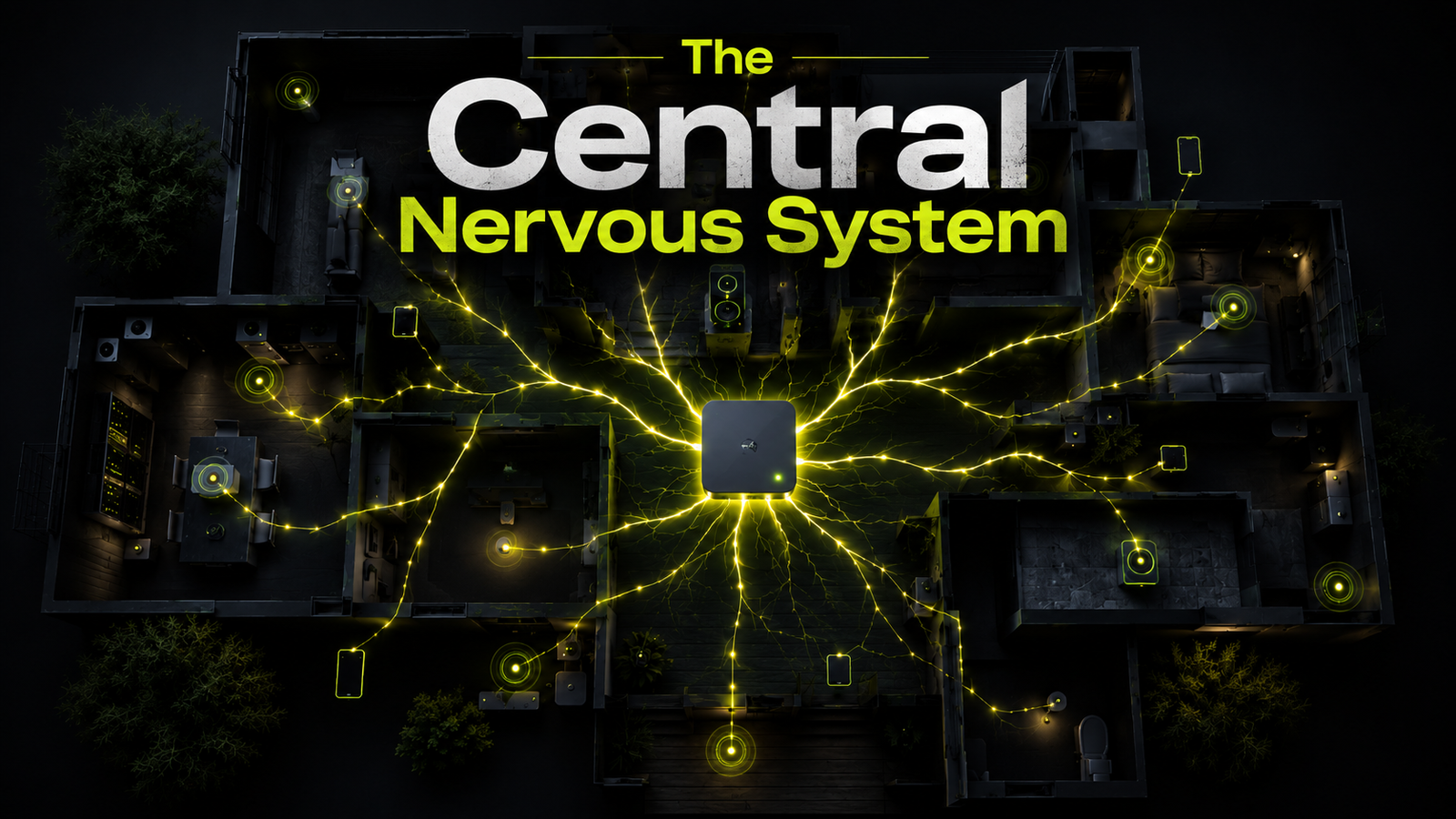
Home Assistant Green: The Central Nervous System
“Old Laptops, a Green Box, and the Beginning of Something” introduced it sitting on a shelf. Now it’s time to explain what it actually does. Home Assistant Green is where every smart device converges, where every automation lives, and where four separate ecosystems learned to talk to each other—locally, without cloud.
Before: The Fragmented Smart Home
Before HA Green, I owned pieces of a smart home. Not a system. Pieces.
An Amazon Echo in the bedroom. Philips Hue lights in four rooms. Sonos speakers in three zones. SmartThings hub running protocols I didn’t fully understand. Motion sensors, door contacts, temperature probes—all reporting to different clouds, all isolated in their own apps, all requiring separate authentication and logic.
The Hue app turned lights on. Alexa could control Hue through a skill, but only if the internet worked. SmartThings sensors couldn’t trigger Hue. Sonos had no idea motion was detected. There was no coherence. There was just stuff plugged in, each device a silo, each one cloud-dependent.
The problem wasn’t the devices. The problem was that they didn’t share a language.
I wanted motion in the hallway to trigger lights and play a welcome through Sonos. I wanted living room presence to dim Hue and resume paused media. I wanted one place to see everything—what’s on, what’s off, what’s happening right now.
The proprietary ecosystems couldn’t deliver that. Alexa routines handled simple cases. IFTTT bridged some gaps. But everything was cloud-first, cloud-dependent, and broke the moment the internet hiccupped or a company changed terms.
I needed a hub. Not a cloud gateway. A local orchestrator that could speak every protocol and make everything aware of everything else.
Why a Dedicated Appliance, Not Docker on Bunty
I could have run Home Assistant as a container on Bunty. One more entry in docker-compose alongside Pi-hole, Immich, Plex, and everything else.
I didn’t. I bought Home Assistant Green—a fanless box about the size of an Echo, pre-configured with Home Assistant OS, sitting in a closet on its own.
Home Assistant Green removes every OS decision. No Ubuntu setup. No Docker learning curve. Plug it in. Boot into HAOS. Configure through a browser. That simplicity is the point. Smart home automation needs to be boring and reliable, not a hobby project requiring constant maintenance.
And because it’s separate from the Bunty/Buntzilla server stack, its failures don’t cascade. If Docker crashes on Bunty, the lights still work. If I need to update Bunty’s OS, HA Green keeps running. Separation of concerns at the hardware level.
Pulling Every Device Into One Place
Home Assistant has integrations for everything. Philips Hue. Sonos. SmartThings. Alexa. A hundred other platforms. All run locally. None require cloud APIs.
Setting up those integrations was the critical step. Each took minutes—API keys, OAuth handshakes, bridge discovery—and suddenly the silos started connecting.
Bridge IP and API key in HA. Every bulb and light group now appears as an entity. Controllable from HA, no Hue app required.
On the same network, auto-discovers. Playback, volume, source, media state—all available to automations.
OAuth with Samsung. Motion sensors, door contacts, temperature probes now report to HA instead of Samsung’s cloud.
Expose HA devices as a smart home skill. Voice commands now trigger HA automations, not just toggle cloud endpoints.
USB coordinator connected to HA Green. Sensors and switches speak Zigbee directly to HA, no bridge required.
Within an afternoon, I had a mental model of the entire house living in one system. Entities. Automations. Scenes. All local. All running without a cloud call. And then the real magic started: making the devices talk to each other.
Automations That Work Across Brands
The first automation was simple: motion detected in the hallway → turn on the hallway light.
That wouldn’t have been possible before. SmartThings sensors didn’t trigger Hue. The ecosystems were separate. Now they weren’t.
Expand that: motion → hallway light on and play a welcome announcement through Sonos. Guest arrives, system speaks. Living room motion detected → dim all Hue bulbs to 40% and pause media. Bedtime triggered → all lights off, all speakers muted, automations disabled. Back door opened → turn on outdoor lights and send a notification.
These rules live in YAML or the HA UI. They trigger locally. No latency waiting for cloud APIs. Instant response.
Home Assistant turned four separate ecosystems into one coherent system. That’s the difference between owning a smart home and being a tenant of one.
The key insight: you’re no longer limited by what each manufacturer intended. Hue lights can respond to SmartThings motion. Sonos can announce events detected by Zigbee sensors. Alexa can trigger automations that have nothing to do with Amazon. The devices stop being isolated islands and become nodes in a network you control.
Why It’s the Central Nervous System
You could describe Home Assistant Green as “just another service.” Technically accurate. It’s software that could run on other hardware.
But that misses what it actually is: the switchboard everything routes through.
Temperature sensor reads? Goes to HA. Motion detected? Goes to HA. User taps the Hue app? HA sees it and re-evaluates automations. Alexa voice command? HA receives it and orchestrates the response. Door opens? HA knows. Sonos starts playing? HA sees the state change. Presence arrives home? HA triggers the scene.
It’s not optional. It’s not an add-on. It’s the hub that every input and output passes through. Nothing happens in the home without HA being aware of it and potentially orchestrating a response.
That’s why it can’t be a container sharing resources with backup jobs or media encoding. The moment HA competes for CPU with other processes, its latency increases. Motion triggers feel slow. Automations stutter. Users notice. A dedicated appliance keeps it responsive, always available, and independent of everything else’s failures.
Fanless. Offline-capable. One job: orchestrate everything else. That’s what a nervous system needs to be.
What Changed
Home Assistant Green consolidated the smart home devices into one orchestration layer. That’s the foundation. But the real power comes from what it listens to: a Zigbee network that knows where people are, room by room, in real time. That presence engine unlocks automations that feel less like rules and more like the house understanding what you need.
That’s Post 04.


Leave a Reply