The Most Terrifying Part Is That He Said It Out Loud
Surveillance is becoming the default. The moment someone admits it openly is the moment you know the architecture has already won.
The Shift Happened Quietly
For most of human history, privacy wasn’t something you had to actively defend. It was the default state of existence.
You went somewhere. You came home. The moment passed.
Today, nearly every action leaves a trail.
Phones record locations. Cameras watch intersections. Vehicles transmit telemetry. Smart devices log behavior. Search engines remember questions. Social networks archive opinions. Retailers track purchases. Streaming services catalog habits.
Individually, each system seems harmless.
Collectively, they form something much larger: a behavioral map. Not of who you are, but of what you do. And increasingly, those two things are treated as the same.
The New Social Contract
The traditional social contract assumed freedom first.
You were free to make mistakes, change your mind, learn, experiment, and occasionally look foolish without creating a permanent record.
The emerging digital contract works differently.
Everything is collected. Everything is stored. Everything is potentially searchable. The assumption becomes not that people deserve privacy, but that people should expect observation.
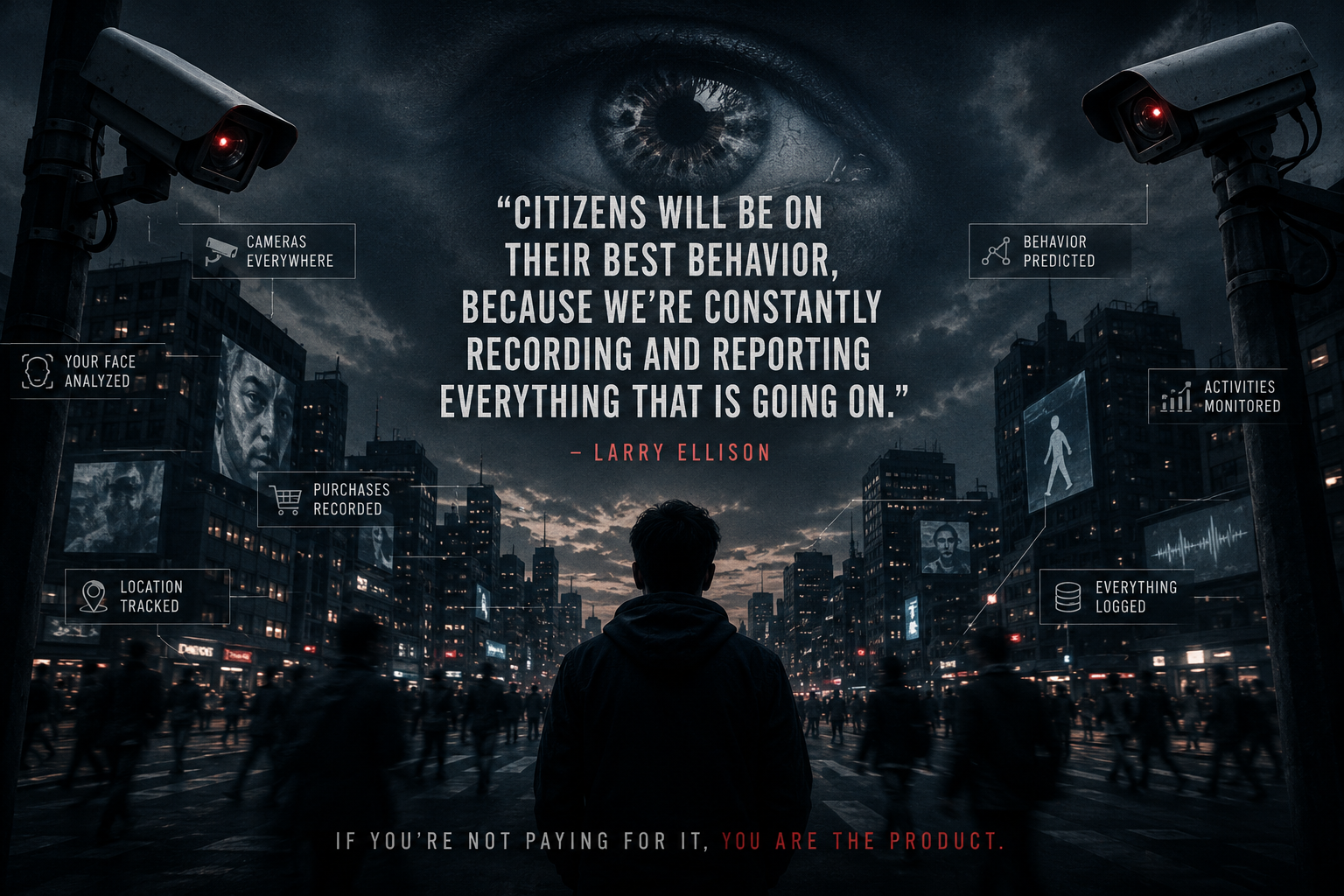
“Citizens will be on their best behavior, because we’re constantly recording and reporting everything that is going on.”
Oracle co-founder Larry Ellison said this. When someone describes a surveillance apparatus as a benefit, and presents it as a form of social control, the moment has already passed. The architecture of observation is so complete that it can be spoken aloud without generating alarm.
When Ellison says citizens will be “on their best behavior,” he is describing a world where surveillance becomes a form of social control—not through force, but through awareness. People behave differently when they know they are being watched. They always have.
The Home Lab Lesson
One of the unexpected lessons from building a self-hosted environment is learning just how much information modern systems generate.
Even simple services create astonishing amounts of behavioral data. DNS requests reveal interests. Presence systems reveal routines. Media systems reveal habits. Health systems reveal patterns.
The difference is ownership.
When the infrastructure lives in your home, on hardware you control, the purpose of the data is explicit. The system exists to serve you.
When that same information is collected by dozens of unrelated companies, the relationship changes. You become both the customer and the product. And increasingly, the product is the behavioral profile.
Privacy Is Not About Having Something to Hide
This is the argument that always appears: “If you’re not doing anything wrong, why do you care?”
Because privacy was never about wrongdoing.
Privacy is where experimentation happens. It’s where ideas are tested before they’re shared. It’s where people learn. It’s where people fail safely.
A society that records everything eventually discourages exploration. People stop asking unusual questions. They stop researching controversial topics. They stop taking intellectual risks.
Not because they are criminals. Because they are human.
The Real Risk
The danger isn’t a single company. It’s not Oracle. It’s not Google. It’s not Meta. It’s not any individual platform.
The danger is normalization.
Every year the surveillance becomes slightly more comprehensive. Every year the data collection becomes slightly more acceptable. Every year another behavior moves from private to public by default. Until one day a billionaire technology executive casually explains that constant recording is desirable, and half the audience barely notices how extraordinary the statement really is.
Final Thought
Technology is at its best when it expands human freedom. The moment a system’s primary value proposition becomes keeping people “on their best behavior,” we’re no longer talking about empowerment. We’re talking about compliance. And those are very different things.
The architecture of privacy loss is rarely built through dramatic events. It arrives one convenience at a time. One camera. One sensor. One account. One agreement nobody reads.
Until eventually someone says the quiet part out loud.

Leave a Reply